
flame test lab answers pdf
Flame Test Lab Answers PDF: A Comprehensive Article Plan
Flame test investigations, often documented in PDF lab reports, reveal elemental identity via emitted light; a crucial skill for chemistry students and professionals alike.
The flame test is a qualitative laboratory technique utilized in chemistry to detect the presence of certain metallic elements, primarily based on their characteristic emission spectra. This straightforward yet insightful experiment involves introducing a small quantity of a substance – typically a metal salt – into a flame. The heat energy excites the electrons within the metal ions, causing them to jump to higher energy levels.
As these excited electrons return to their ground state, they release energy in the form of light. Crucially, the wavelength (and therefore color) of this emitted light is unique to each metal. Observing these distinct flame colors allows for the identification of the element present in the original sample. This technique serves as a foundational concept in understanding atomic structure and the relationship between energy and light, often documented in detailed flame test lab answers PDF resources.
The Science Behind Flame Colors
The vibrant hues observed during a flame test aren’t arbitrary; they stem from the fundamental principles of atomic physics. When a metal salt is heated, the metal ions absorb thermal energy, causing electrons to transition from their ground state to higher, excited energy levels. This state is unstable, and the electrons quickly fall back to their original energy level, releasing the absorbed energy as photons – packets of light.
The energy difference between these levels dictates the wavelength, and thus the color, of the emitted light. Each metal possesses a unique electron configuration, resulting in distinct energy level spacings and, consequently, unique flame colors; Detailed explanations and expected results are often compiled in comprehensive flame test lab answers PDF guides, aiding in understanding these spectral emissions.
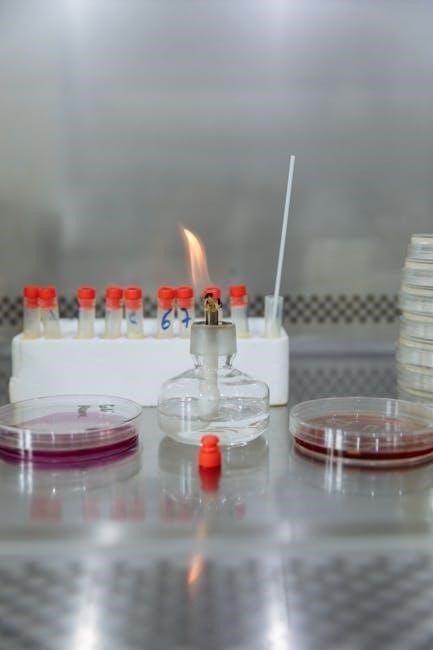
Principle of Atomic Emission
Atomic emission occurs when excited electrons return to their ground state, releasing energy as photons. This principle underpins the flame test, where thermal energy from the flame excites metal ions. The emitted photons possess specific wavelengths corresponding to the energy differences within the atom’s electron structure.

Each element exhibits a unique emission spectrum – a fingerprint of wavelengths – allowing for its identification. Flame test lab answers PDF resources often detail these spectra, providing expected color outcomes for various metal ions. Understanding this principle is crucial for interpreting experimental results and accurately identifying unknown samples. The intensity of the color relates to the concentration of the metal ion present, offering a semi-quantitative analysis.
Electron Excitation and Energy Levels
Electrons within atoms occupy discrete energy levels. When a metal salt is introduced to a flame, the heat energy excites these electrons, causing them to jump to higher, unoccupied energy levels. This state is unstable, and the electrons quickly fall back to their original, lower energy levels.
As they descend, the excess energy is released in the form of light – a photon. The wavelength (and thus color) of this emitted light is directly proportional to the energy difference between the levels. Flame test lab answers PDF guides explain how these transitions relate to observed flame colors. This process demonstrates the quantized nature of electron energy and forms the basis for elemental identification.
Materials Required for the Experiment
A successful flame test requires specific materials. Essential components include various metal salt samples – nitrates, chlorides, or carbonates are commonly used. These salts are the source of the metal ions being tested. A Bunsen burner provides the necessary heat source, and distilled water is crucial for preparing salt solutions.
Platinum or nichrome wire loops serve as applicators to introduce the samples into the flame. Hydrochloric acid aids in cleaning the wire between tests, preventing contamination. Safety goggles are paramount for eye protection. Flame test lab answers PDF resources often list these materials, alongside detailed instructions for safe and accurate experimentation. A lab coat is also recommended for protection.
Metal Salts Used in Flame Tests
Flame tests utilize metal salts to reveal elemental identities through characteristic emissions. Common salts include lithium chloride (LiCl), producing a crimson red flame; sodium chloride (NaCl), yielding an intense yellow; potassium chloride (KCl), displaying a lilac/violet hue (often viewed through cobalt blue glass).
Calcium chloride (CaCl2) generates an orange-red flame, while strontium chloride (SrCl2) produces a vibrant red. Barium chloride (BaCl2) creates a yellow-green flame, and copper(II) chloride (CuCl2) results in a blue-green emission. Flame test lab answers PDF guides frequently detail these salts and their expected colors. Using high-purity salts is vital for accurate results, minimizing interference and ensuring clear color observation.
Equipment Setup and Safety Precautions
A standard flame test setup includes a Bunsen burner, metal wire loops, concentrated hydrochloric acid (HCl), distilled water, and the metal salt samples. Safety is paramount; always wear appropriate personal protective equipment (PPE), including safety goggles, to shield eyes from chemical splashes and intense light.
Handle HCl with extreme caution, as it’s corrosive. Clean the wire loops thoroughly before each use by dipping them in HCl, then heating in the flame, and rinsing with distilled water – this prevents contamination. Ensure a well-ventilated area is used. Flame test lab answers PDF resources often emphasize these safety protocols. Never directly insert solid salts into the flame; dissolve them first.
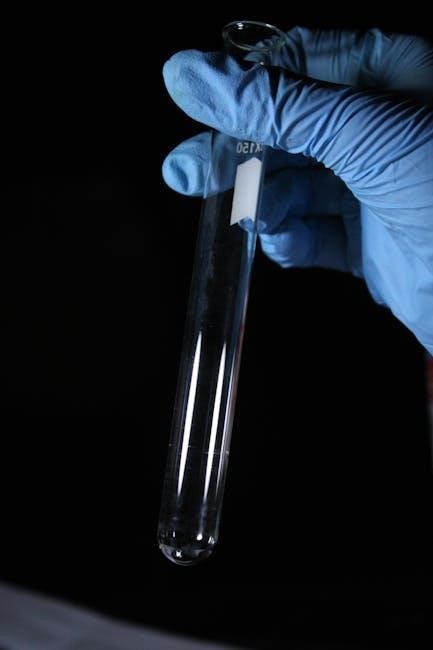
Procedure for Performing a Flame Test
Begin by cleaning a platinum or nichrome wire loop with concentrated hydrochloric acid, then heat it in the Bunsen burner flame until no color is observed. Dip the cleaned loop into a small amount of the metal salt sample. Introduce the loop into the hottest part of the flame and observe the resulting color.
Record your observations meticulously, noting the specific hue and intensity of the flame. Repeat this process for each metal salt, ensuring the loop is cleaned between samples to avoid cross-contamination. Flame test lab answers PDF guides often detail this step-by-step process. Rinse the loop with distilled water after each test. Accurate observation is key to correct identification.
Preparing the Samples
Flame test lab answers PDF resources emphasize proper sample preparation for accurate results. Typically, metal salts are provided in solid form. If necessary, dissolve a small amount of the salt in distilled water to create a concentrated solution. This facilitates easier transfer to the wire loop.
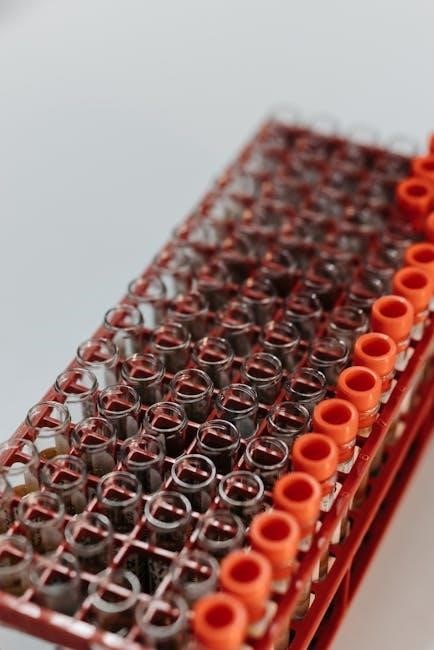
However, direct use of the solid is also common. Ensure the samples are free from contaminants, as these can interfere with the flame color. A small spatula or scoopula is used to obtain a tiny amount of the metal salt. Proper handling prevents accidental spills and ensures consistent sample size. Thorough preparation is vital for reliable flame test outcomes.
Observing and Recording Flame Colors

Flame test lab answers PDF guides stress meticulous observation and recording of flame colors. View the flame against a dark background to enhance color visibility. Note the dominant color immediately after introducing the sample; colors can change rapidly.
Detailed descriptions are crucial – avoid simply stating “red”; instead, specify “bright red,” “pale orange-red,” or “crimson.” Record observations in a data table, noting the metal salt used and the corresponding flame color. Multiple observations are recommended to confirm consistency. Accurate color documentation is fundamental to correctly identifying the metal ions present, as detailed in many PDF lab report examples.
Identifying Unknown Metal Ions
Flame test lab answers PDF resources emphasize comparing observed flame colors to known standards for accurate identification of unknown metal ions. Utilize a reference chart detailing expected flame colors for common metals like sodium (yellow), potassium (violet), and lithium (red).
Carefully analyze any color variations; mixtures can produce complex hues. Consider potential interferences, such as sodium contamination causing a persistent yellow flame. Cross-reference your observations with the data table and known spectral lines. Many PDF guides provide troubleshooting tips for ambiguous results; Confirm your identification by considering other chemical tests if necessary, ensuring a reliable conclusion.
Expected Flame Colors for Common Metals
Flame test lab answers PDF documents consistently highlight predictable color emissions for specific metals. Sodium (Na) typically produces a vibrant yellow flame, easily observed. Potassium (K) yields a lilac or violet hue, often faint and best viewed through cobalt blue glass to mask sodium interference; Lithium (Li) generates a crimson red flame, though intensity can vary.
Calcium (Ca) displays an orange-red color, while strontium (Sr) produces a strong red. Barium (Ba) emits a pale green flame, and copper (Cu) creates a blue or blue-green color. These expected results, detailed in PDF guides, serve as benchmarks for identifying unknown metal ions during experimentation and analysis.
Sodium (Na) Flame Color
Flame test lab answers PDF resources universally identify sodium (Na) with an intense, persistent yellow flame color. This strong emission is due to the relatively low energy required to excite sodium’s valence electron. Even trace amounts of sodium contamination can dominate a flame test, masking other colors.
Consequently, PDF guides often recommend using a cobalt blue glass filter when observing other metal ions, as it absorbs yellow light, allowing subtler colors to become visible. The characteristic yellow of sodium is a key identifier, frequently used in introductory chemistry experiments and detailed in comprehensive lab report templates.
Potassium (K) Flame Color
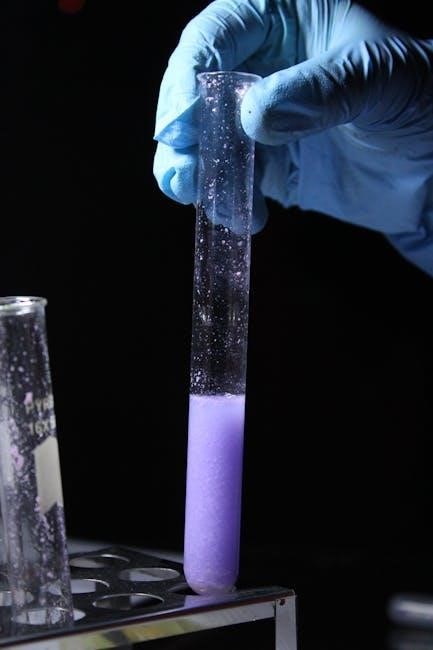
Flame test lab answers PDF materials consistently describe potassium’s (K) flame color as lilac or pale violet. However, observing this color can be challenging. The violet hue is often faint and easily obscured by the ubiquitous yellow emission from even minor sodium contamination.
Therefore, PDF resources emphasize the necessity of viewing the flame through a cobalt blue glass filter. This filter effectively blocks the intense yellow sodium light, enabling clearer visualization of the potassium violet. Detailed lab report templates often include specific instructions regarding filter use. Accurate identification relies on careful observation and acknowledging potential interference, as highlighted in many online guides.
Lithium (Li) Flame Color
Flame test lab answers PDF documents universally state that lithium (Li) produces a crimson or deep red flame color. This color is generally more readily observable than potassium’s violet, making lithium identification somewhat easier. However, the intensity of the red color can vary depending on the concentration of lithium ions present in the sample.
Many PDF guides and lab report templates advise students to use a clean platinum or nichrome wire to avoid contamination from previous samples. Contamination can significantly alter the observed flame color. Resources also emphasize the importance of comparing the observed color to known standards or color charts to ensure accurate identification, as detailed in comprehensive experiment write-ups.

Analyzing Flame Test Results
Flame test lab answers PDF resources consistently highlight the importance of careful observation and comparison when analyzing results. A successful analysis involves meticulously recording the observed flame colors for each metal salt tested, often using a pre-formatted data table found in lab report templates.
Interpreting color variations is crucial; slight deviations from expected colors can indicate impurities or incomplete combustion. Many PDF guides emphasize cross-referencing observed colors with established standards. Students are often prompted to consider potential sources of error, such as contaminated wires or insufficient sample quantity, as detailed in comprehensive lab reports. Accurate identification relies on a systematic approach and critical evaluation of the data.
Data Table for Recording Observations
Flame test lab answers PDF documents invariably include a sample data table as a cornerstone of the experimental process. This table typically features columns for “Metal Salt,” “Observations (Flame Color),” and potentially “Observations (Intensity/Brightness).” Some templates also include a space for noting any unusual characteristics.
Effective data recording demands precise color descriptions – avoiding vague terms like “orange” and opting for specifics like “brick red” or “pale violet.” Many PDF resources stress the importance of recording observations immediately, as color perception can fade. A well-structured data table, often found within a complete lab report, is essential for accurate analysis and drawing valid conclusions from the experiment.
Interpreting Color Variations
Analyzing discrepancies in observed flame colors is a key component of understanding flame test lab answers PDF results. Slight variations can arise from impurities within the metal salt samples, impacting the emitted wavelengths. The concentration of the metal ion also plays a role; higher concentrations generally produce more vibrant colors.
PDF guides often emphasize that overlapping wavelengths can mask true colors. For example, trace amounts of sodium can create a persistent yellow hue, interfering with the identification of other metals. Careful observation, coupled with a thorough understanding of expected flame colors, is crucial. A comprehensive lab report template will guide students through this interpretive process, ensuring accurate conclusions are drawn.
Common Sources of Error in Flame Tests
When reviewing flame test lab answers PDF documents, recognizing potential errors is vital for accurate analysis. Contamination is a frequent issue; even minute traces of sodium can dominate the spectrum with its intense yellow color, masking other elements. Inconsistent sample preparation – uneven distribution on the wire loop – can lead to variable flame intensities and color interpretations.
Furthermore, subjective color perception differs between observers. A well-structured lab report template should encourage multiple observations. The type of burner and its cleanliness also influence results. PDF resources often highlight the importance of using distilled water for cleaning to avoid introducing contaminants. Understanding these error sources strengthens the validity of experimental findings.
Flame Test Lab Report Template

A comprehensive flame test lab report template, often available as a PDF, typically begins with a clear statement of the experiment’s purpose and a formulated hypothesis. The procedure section details the materials used and the steps followed, ensuring reproducibility; A meticulously organized data table is crucial for recording observations – specifically, the metal salt tested and the corresponding flame color observed.
The results section presents these observations, while the discussion interprets the findings, linking observed colors to specific metal ions. Many flame test lab answers PDF examples emphasize a thorough error analysis. Finally, a concise conclusion summarizes the experiment’s success in verifying the hypothesis, referencing the principles of atomic emission and electron excitation.
Hypothesis Formulation
When constructing a hypothesis for a flame test lab, a strong statement predicts the relationship between metal ions and their emitted flame colors. A well-defined hypothesis, often found within flame test lab answers PDF resources, might state: “Different metal ions will produce unique and distinguishable flame colors when heated, corresponding to their specific electron energy level transitions.”
This prediction stems from the understanding of atomic emission spectra. Students should clearly identify the independent variable (the metal ion) and the dependent variable (the flame color). A good hypothesis is testable through observation and data collection. PDF guides often suggest formulating multiple hypotheses to explore potential variations and complexities within the experiment’s results.
Writing Guide
A robust conclusion for a flame test lab report, often detailed in flame test lab answers PDF examples, should summarize findings and relate them back to the initial hypothesis. Begin by restating the hypothesis and clearly stating whether the experimental data supported or refuted it. Discuss observed flame colors and their correlation to identified metal ions.
Address any discrepancies or unexpected results, proposing potential sources of error. A comprehensive conclusion also acknowledges limitations of the experiment and suggests avenues for further investigation. PDF templates frequently emphasize the importance of connecting observations to the underlying scientific principles of atomic emission and electron excitation. Finally, briefly reiterate the significance of the experiment’s findings.
Finding Flame Test Lab Answers PDF Online
Locating flame test lab answers PDF resources requires careful navigation. Educational websites, like those of universities or chemistry resource centers, often host sample lab reports and answer keys. Searching specifically for “flame test lab report example PDF” or “flame test lab answers” yields numerous results, but verifying source credibility is crucial.
Beware of websites offering complete solutions without educational context; these hinder genuine learning. Platforms like Quizlet or Course Hero may contain student-submitted answers, but accuracy isn’t guaranteed. PDF documents from established educational institutions provide reliable examples for understanding expected report formats and correct interpretations. Remember, using PDF answers for direct copying is academic dishonesty; utilize them for learning and comprehension.